

 Facebook
 Twitter
 Vimeo
Vimeo
32205
thunderlane12@gmail.com
BURR OAK WOODS
http://mdc.mo.gov
GO Conservation Commission

Subscribe


 @MizzouNews
For Media Inquiries
MU News Bureau329 Jesse Hall
Columbia, MO 65211
Phone: 573-882-6211
Fax: 573-882-5489
E-mail: munewsbureau@missouri.edu

Upcoming Events
MEDIA ADVISORY: MU to Recognize Faculty, Staff and Student EntrepreneursMEDIA ADVISORY: MU Celebrates Acts of Kindness Week
CALENDAR ITEM: Midwest Macroeconomics Conference
Expert Comment
EXPERT AVAILABLE: MU Scholar Suggests ‘Place-Based Struggles,’ Including Ecological Fights Involving Tribal Groups, are Influencing Local Government and Politics“Place-based identity” is the idea that people form a sense of place and establish connections to a geographical area. Often, place-based struggles arise when that sense of home is threatened by development and perceived ecological threats. Soren Larsen, associate professor of geography in the MU College of Arts and Science, is studying a Midwest place-based struggle focusing on the Wakarusa wetlands that are affiliated with Haskell Indian Nations University in Kansas. Using interviewing and participant observation, Larsen and his colleague are working to understand the sometimes antagonistic ways in which groups communicate—battles that also are transforming government, communities and politics within those groups.
More expert comments »
Mizzou in the News
Fox News
April 29, 2014
In the B2B World, Fairness Doesn't Always TranslatePopular Science
April 28, 2014
Researchers Track Isolated Amazonian Tribe With Google Earth
 photo
photo
Published by the MU News Bureau, 329 Jesse Hall, Columbia, MO 65211 | Phone: 573-882-6211 | Fax: 573-882-5489 | E-mail: munewsbureau@missouri.edu
Copyright © 2014 — Curators of the University of Missouri. All rights reserved. DMCA and other copyright information. An equal opportunity/ADA institution.

 Land management policies have been developed to preserve the natural characteristics of Hopetoun Falls, Australia while allowing ample access for visitors
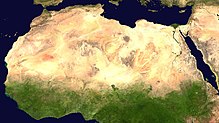
A satellite image of the Sahara desert; the world's largest hot desert and third-largest desert after Antarctica and the Arctic
The natural environment encompasses all living and non-living things occurring naturally on Earth or some region thereof. It is an environment that encompasses the interaction of all living species.[1] The concept of the natural environment can be distinguished by components:
It is difficult to find absolutely natural environments, and it is common that the naturalness varies in a continuum, from ideally 100% natural in one extreme to 0% natural in the other. More precisely, we can consider the different aspects or components of an environment, and see that their degree of naturalness is not uniform.[2] If, for instance, we take an agricultural field, and consider the mineralogic composition and the structure of its soil, we will find that whereas the first is quite similar to that of an undisturbed forest soil, the structure is quite different.
Natural environment is often used as a synonym for habitat. For instance, when we say that the natural environment of giraffes is the savanna.
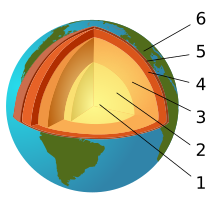
The Earth's layered structure. (1) inner core; (2) outer core; (3) lower mantle; (4) upper mantle; (5) lithosphere; (6) crust
Natural lakes on Earth are generally found in mountainous areas, rift zones, and areas with ongoing or recent glaciation. Other lakes are found in endorheic basins or along the courses of mature rivers. In some parts of the world, there are many lakes because of chaotic drainage patterns left over from the last Ice Age. All lakes are temporary over geologic time scales, as they will slowly fill in with sediments or spill out of the basin containing them.
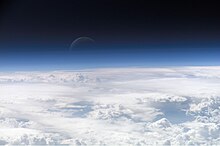
Atmospheric gases scatter blue light more than other wavelengths, creating a blue halo when seen from space.

Lightning is an atmospheric discharge of electricity accompanied by thunder, which typically occurs during thunderstorms, and sometimes during volcanic eruptions or dust storms.[15]
The atmosphere of the Earth serves as a key factor in sustaining the planetary ecosystem. The thin layer of gases that envelops the Earth is held in place by the planet's gravity. Dry air consists of 78% nitrogen, 21% oxygen, 1% argon and other inert gases, such as carbon dioxide. The remaining gases are often referred to as trace gases,[16] among which are the greenhouse gases such as water vapor, carbon dioxide, methane, nitrous oxide, and ozone. Filtered air includes trace amounts of many other chemical compounds. Air also contains a variable amount of water vapor and suspensions of water droplets and ice crystals seen as clouds. Many natural substances may be present in tiny amounts in an unfiltered air sample, including dust, pollen and spores, sea spray, volcanic ash, and meteoroids. Various industrial pollutants also may be present, such as chlorine (elementary or in compounds), fluorine compounds, elemental mercury, and sulphur compounds such as sulphur dioxide [SO2].
The ozone layer of the Earth's atmosphere plays an important role in depleting the amount of ultraviolet (UV) radiation that reaches the surface. As DNA is readily damaged by UV light, this serves to protect life at the surface. The atmosphere also retains heat during the night, thereby reducing the daily temperature extremes.
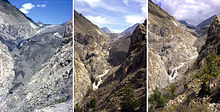
The Retreat of glaciers since 1850 of Aletsch Glacier in the Swiss Alps (situation in 1979, 1991 and 2002), due to global warming.
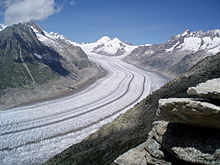
Another view of the Aletsch Glacier in the Swiss Alps and because of global warming it has been decreasing
Climates can be classified according to the average and typical ranges of different variables, most commonly temperature and precipitation. The most commonly used classification scheme is the one originally developed by Wladimir Köppen. The Thornthwaite system,[21] in use since 1948, incorporates evapotranspiration in addition to temperature and precipitation information and is used in studying animal species diversity and potential impacts of climate changes.[citation needed]
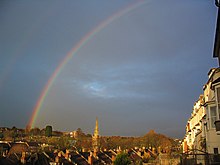
Rainbows are optical and meteorological phenomenon that causes a spectrum of light to appear in the sky when the Sun shines onto droplets of moisture in the Earth's atmosphere.
Weather occurs due to density (temperature and moisture) differences between one place and another. These differences can occur due to the sun angle at any particular spot, which varies by latitude from the tropics. The strong temperature contrast between polar and tropical air gives rise to the jet stream. Weather systems in the mid-latitudes, such as extratropical cyclones, are caused by instabilities of the jet stream flow. Because the Earth's axis is tilted relative to its orbital plane, sunlight is incident at different angles at different times of the year. On the Earth's surface, temperatures usually range ±40 °C (100 °F to −40 °F) annually. Over thousands of years, changes in the Earth's orbit have affected the amount and distribution of solar energy received by the Earth and influence long-term climate
Surface temperature differences in turn cause pressure differences. Higher altitudes are cooler than lower altitudes due to differences in compressional heating. Weather forecasting is the application of science and technology to predict the state of the atmosphere for a future time and a given location. The atmosphere is a chaotic system, and small changes to one part of the system can grow to have large effects on the system as a whole. Human attempts to control the weather have occurred throughout human history, and there is evidence that human activity such as agriculture and industry has inadvertently modified weather patterns.
Evidence suggests that life on Earth has existed for about 3.7 billion years.[26]
All known life forms share fundamental molecular mechanisms, and based
on these observations, theories on the origin of life attempt to find a
mechanism explaining the formation of a primordial single cell organism
from which all life originates. There are many different hypotheses
regarding the path that might have been taken from simple organic molecules via pre-cellular life to protocells and metabolism.
Although there is no universal agreement on the definition of life, scientists generally accept that the biological manifestation of life is characterized by organization, metabolism, growth, adaptation, response to stimuli and reproduction.[27] Life may also be said to be simply the characteristic state of organisms. In biology, the science of living organisms, "life" is the condition which distinguishes active organisms from inorganic matter, including the capacity for growth, functional activity and the continual change preceding death.[28][29]
A diverse variety of living organisms (life forms) can be found in the biosphere on Earth, and properties common to these organisms—plants, animals, fungi, protists, archaea, and bacteria—are a carbon- and water-based cellular form with complex organization and heritable genetic information. Living organisms undergo metabolism, maintain homeostasis, possess a capacity to grow, respond to stimuli, reproduce and, through natural selection, adapt to their environment in successive generations. More complex living organisms can communicate through various means.

Rainforests often have a great deal of biodiversity with many plant and animal species. This is the Gambia River in Senegal's Niokolo-Koba National Park.
Central to the ecosystem concept is the idea that living organisms are continually engaged in a highly interrelated set of relationships with every other element constituting the environment in which they exist. Eugene Odum, one of the founders of the science of ecology, stated: "Any unit that includes all of the organisms (ie: the "community") in a given area interacting with the physical environment so that a flow of energy leads to clearly defined trophic structure, biotic diversity, and material cycles (i.e.: exchange of materials between living and nonliving parts) within the system is an ecosystem."[31]
The human ecosystem concept is then grounded in the deconstruction of the human/nature dichotomy,
and the emergent premise that all species are ecologically integrated
with each other, as well as with the abiotic constituents of their biotope.
A greater number or variety of species or biological diversity of an ecosystem may contribute to greater resilience of an ecosystem, because there are more species present at a location to respond to change and thus "absorb" or reduce its effects. This reduces the effect before the ecosystem's structure is fundamentally changed to a different state. This is not universally the case and there is no proven relationship between the species diversity of an ecosystem and its ability to provide goods and services on a sustainable level.
The term ecosystem can also pertain to human-made environments, such as human ecosystems and human-influenced ecosystems, and can describe any situation where there is relationship between living organisms and their environment. Fewer areas on the surface of the earth today exist free from human contact, although some genuine wilderness areas continue to exist without any forms of human intervention.

Chloroplasts conduct photosynthesis and are found in plant cells and other eukaryotic organisms. These are Chloroplasts visible in the cells of Plagiomnium affine — Many-fruited Thyme-moss.
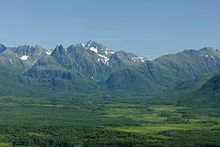
The Ahklun Mountains and the Togiak Wilderness within the Togiak National Wildlife Refuge in the U.S. state of Alaska.
The word, "wilderness", derives from the notion of wildness; in other words that which is not controllable by humans. The word's etymology is from the Old English wildeornes, which in turn derives from wildeor meaning wild beast (wild + deor = beast, deer).[35] From this point of view, it is the wildness of a place that makes it a wilderness. The mere presence or activity of people does not disqualify an area from being "wilderness." Many ecosystems that are, or have been, inhabited or influenced by activities of people may still be considered "wild." This way of looking at wilderness includes areas within which natural processes operate without very noticeable human interference.
Wildlife includes all non-domesticated plants, animals and other organisms. Domesticating wild plant and animal species for human benefit has occurred many times all over the planet, and has a major impact on the environment, both positive and negative. Wildlife can be found in all ecosystems. Deserts, rain forests, plains, and other areas—including the most developed urban sites—all have distinct forms of wildlife. While the term in popular culture usually refers to animals that are untouched by human factors, most scientists agree that wildlife around the world is impacted by human activities.

Before flue-gas desulfurization was installed, the air-polluting emissions from this power plant in New Mexico contained excessive amounts of sulfur dioxide
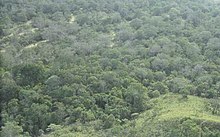
Amazon Rainforest in Brazil.
The tropical rainforests of South America contain the largest diversity
of species on Earth, including some that have evolved within the past
few hundred thousand years.[36][37]
Goals commonly expressed by environmental scientists include:


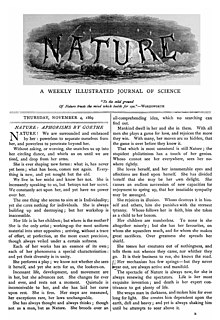 Cover of the first issue of Nature, 4 November 1869.
In academic publishing, a scientific journal is a periodical publication intended to further the progress of science, usually by reporting new research.
There are thousands of scientific journals in publication, and many
more have been published at various points in the past (see list of scientific journals). Most journals are highly specialized, although some of the oldest journals such as Nature publish articles and scientific papers across a wide range of scientific fields. Scientific journals contain articles that have been peer reviewed, in an attempt to ensure that articles meet the journal's standards of quality, and scientific validity. Although scientific journals are superficially similar to professional magazines,
they are actually quite different. Issues of a scientific journal are
rarely read casually, as one would read a magazine. The publication of
the results of research is an essential part of the scientific method.
If they are describing experiments or calculations, they must supply
enough details that an independent researcher could repeat the
experiment or calculation to verify the results. Each such journal
article becomes part of the permanent scientific record.
The history of scientific journals dates from 1665, when the French Journal des sçavans and the English Philosophical Transactions of the Royal Society first began systematically publishing research results. Over a thousand, mostly ephemeral, were founded in the 18th century, and the number has increased rapidly after that.[1]
Articles in scientific journals can be used in research and higher education. Some classes are partially devoted to the explication of classic articles, and seminar classes can consist of the presentation by each student of a classic or current paper. In a scientific research group or academic department it is usual for the content of current scientific journals to be discussed in journal clubs.
The standards that a journal uses to determine publication can vary widely. Some journals, such as Nature, Science, PNAS, and Physical Review Letters, have a reputation of publishing articles that mark a fundamental breakthrough in their respective fields. In many fields, an informal hierarchy of scientific journals exists; the most prestigious journal in a field tends to be the most selective in terms of the articles it will select for publication, and will also have the highest impact factor. It is also common for journals to have a regional focus, specializing in publishing papers from a particular country or other geographic region, like African Invertebrates.
Articles tend to be highly technical, representing the latest theoretical research and experimental results in the field of science covered by the journal. They are often incomprehensible to anyone except for researchers in the field and advanced students. In some subjects this is inevitable given the nature of the content. Usually, rigorous rules of scientific writing are enforced by the editors; however, these rules may vary from journal to journal, especially between journals from different publishers.
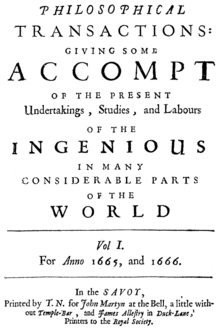 Cover of the first volume of the Philosophical Transactions of the Royal Society, the first journal in the world exclusively devoted to science
There are several types of journal articles; the exact terminology and definitions vary by field and specific journal, but often include:
Cover of the first volume of the Philosophical Transactions of the Royal Society, the first journal in the world exclusively devoted to science
There are several types of journal articles; the exact terminology and definitions vary by field and specific journal, but often include:
In addition to the above, some scientific journals such as Science will include a news section where scientific developments (often involving political issues) are described. These articles are often written by science journalists and not by scientists. In addition, some journals will include an editorial section and a section for letters to the editor. While these are articles published within a journal, in general they are not regarded as scientific journal articles because they have not been peer-reviewed.
Electronical publishing will exist alongside paper publishing, because printed paper publishing is not expected to disappear in the future. Output to a screen is important for browsing and searching but is not well adapted for extensive reading. Paper copies of selected information will definitely be required. Therefore the article has to be transmitted electronically to the reader's local printer. Formats suitable both for reading on paper, and for manipulation by the reader's computer will need to be integrated.[2][3] Many journals are electronically available in formats readable on screen via web browsers, as well as in portable document format PDF, suitable for printing and storing on a local desktop or laptop computer. New tools such as Utopia Documents provide a 'bridge' to the 'web-versions' in that they connect the content in PDF versions directly to the WorldWideWeb via hyperlinks that are created 'on-the-fly'. The PDF version of an article is usually seen as the version of record, but the matter is subject to some debate.[4]
Electronic counterparts of established print journals already promote and deliver rapid dissemination of peer reviewed and edited, "published" articles. Other journals, whether spin-offs of established print journals, or created as electronic only, have come into existence promoting the rapid dissemination capability, and availability, on the Internet. In tandem with this is the speeding up of peer review, copyediting, page makeup, and other steps in the process to support rapid dissemination.[citation needed]
Other improvements, benefits and unique values of electronically publishing the scientific journal are lower cost, and availability to more people, especially scientists from non-developed countries. Hence, research results from more developed nations are becoming more accessible to scientists from non-developed countries.[2]
Moreover, electronic publishing of scientific journals has been accomplished without compromising the standards of the refereed, peer review process.[2][3]
One form is the online equivalent of the conventional paper journal. By 2006, almost all scientific journals have, while retaining their peer-review process, established electronic versions; a number have moved entirely to electronic publication. In similar manner, most academic libraries buy the electronic version, and purchase a paper copy only for the most important or most-used titles.
There is usually a delay of several months after an article is written before it is published in a journal, making paper journals not an ideal format for announcing the latest research. Many journals now publish the final papers in their electronic version as soon as they are ready, without waiting for the assembly of a complete issue, as is necessary with paper. In many fields in which even greater speed is wanted, such as physics, the role of the journal at disseminating the latest research has largely been replaced by preprint databases such as arXiv.org. Almost all such articles are eventually published in traditional journals, which still provide an important role in quality control, archiving papers, and establishing scientific credit.
Publications by scholarly societies, also known as not-for-profit-publishers (NFP), usually cost less than commercial publishers, but the prices of their scientific journals are still usually several thousand dollars a year. In general, this money is used to fund the activities of the scientific societies that run such journals, or is invested in providing further scholarly resources for scientists; thus, the money remains in and benefits the scientific sphere.
Despite the transition to electronic publishing, the serials crisis persists.[5]
Concerns about cost and open access have led to the creation of free-access journals such as the Public Library of Science (PLoS) family and partly open or reduced-cost journals such as the Journal of High Energy Physics. However, professional editors still have to be paid, and PLoS still relies heavily on donations from foundations to cover the majority of its operating costs; smaller journals do not often have access to such resources.
An article titled "Online or Invisible?" [6] has used statistical arguments to show that electronic publishing online, and to some extent open access, both provide wider dissemination and increase the average number of citations an article receives. Lawrence postulates that papers that are easier to access are used more often and therefore cited more often.
Even if they retain the copyright to an article, most journals allow certain rights to their authors. These rights usually include the ability to reuse parts of the paper in the author's future work, and allow the author to distribute a limited number of copies. In the print format, such copies are called reprints; in the electronic format, they are called postprints. Some publishers, for example the American Physical Society, also grant the author the right to post and update the article on the author's or employer's website and on free e-print servers, to grant permission to others to use or reuse figures, and even to reprint the article as long as no fee is charged.[8] The rise of open access journals, in which the author retains the copyright but must pay a publication charge, such as the Public Library of Science family of journals, is another recent response to copyright concerns.
The Wikimedia Foundation or WMF (a.k.a. the Foundation)—based in San Francisco—is the organization that owns the domain en.wikipedia.org.[1] It is an organization that raises money, distributes grants, develops software, deploys software, controls the servers, and does outreach to support Wikimedia projects, including the English Wikipedia. The WMF does not edit Wikipedia content. The community handles content, because if the WMF did take responsibility for content, it would introduce liability issues per Section 230 of the Communications Decency Act. Occasional office actions do occur, however.
The organization grew quickly. In 2006, there were five employees and about $2.7 million in revenue. As of 2012, there were approximately 140 employees and a revenue of about $38 million (mostly from donations). As of 2014, there are approximately 200 employees.[2] Many current employees had their start as respected Wikipedia volunteers.
User:Sue Gardner (Sue Gardner) is the executive director (ED), though she will be leaving in the near future and the board is looking for a replacement. The m:Executive Director Transition Team tentatively says a new ED could be found by May 2014. The WMF also has an Advisory Board. See strategy:Task force/Strategy/Plan overview for old community discussion on strategy.
If you have a general question for the WMF that is more general than just English Wikipedia, then that can go to answers wikimedia.org (and here are some previous answers).
If you have an idea/question about how the WMF supports or could
perhaps more effectively support English Wikipedia, feel free to contact
Mdennis (WMF) (Maggie Dennis) at her talk page. You can also be a friendly talk page stalker there or if you'd rather email her, do so at liaisonwikimedia.org. There are other ways to contact the WMF or the WMF-affiliated chapters (which are mostly national in scope).
wikimedia.org (and here are some previous answers).
If you have an idea/question about how the WMF supports or could
perhaps more effectively support English Wikipedia, feel free to contact
Mdennis (WMF) (Maggie Dennis) at her talk page. You can also be a friendly talk page stalker there or if you'd rather email her, do so at liaisonwikimedia.org. There are other ways to contact the WMF or the WMF-affiliated chapters (which are mostly national in scope).
ACTRIAL was important because it showed this.

 Map of Minnesota with the Iron Range highlighting.
 Iron ore
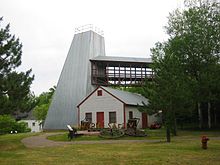 Croft Mine Historic Park
The Iron Range is an informal and unofficially designated region that makes up the northeastern section of Minnesota in the United States. It is a region with multiple distinct bands of iron ore. It's colloquially known through the rest of Minnesota as "da Range." The far eastern area, containing the Duluth Complex along the shore of Lake Superior, and the far northern area, along the Canadian border, of the region are not associated with iron ore mining. Due to its shape, the area is collectively referred to as the Arrowhead region of the state.
Croft Mine Historic Park
The Iron Range is an informal and unofficially designated region that makes up the northeastern section of Minnesota in the United States. It is a region with multiple distinct bands of iron ore. It's colloquially known through the rest of Minnesota as "da Range." The far eastern area, containing the Duluth Complex along the shore of Lake Superior, and the far northern area, along the Canadian border, of the region are not associated with iron ore mining. Due to its shape, the area is collectively referred to as the Arrowhead region of the state.
The area consists of seven counties: Aitkin, Carlton, Cook, Itasca, Koochiching, Lake, and Saint Louis.
The Iron Range Resources and Rehabilitation Board (IRRRB), sometimes known simply as "the I-triple-R-B" or Iron Range Resources,[2] is an economic development agency funded partly by taxes levied by the state on taconite-producing companies and charged with creating jobs.
The history of mining on the Iron Range began in the late 19th century following a report that there were deposits of gold on the shores of Lake Vermilion. Although miners never found commercially valuable amounts of gold in the region, the reports led to an increase in the region's population. Iron ore was first discovered in the northern Vermilion iron range, where underground mines developed to remove the valuable ore. The discovery of hematite on the large Mesabi range cemented the area's position as the foremost source for iron ore throughout the early 20th century. Iron mining operations on the Mesabi range took place in enormous open pit mines where steam shovels and other industrial machines could remove massive amounts of ore. Amid worries that the rich hematite ore would give out, mining operations turned to low grade taconite as a source of iron ore in the second half of the 20th century.
Bob Dylan memorialized the Iron Range in the 1963 song North Country Blues, a lament portraying hard times in the region. Presented in his 1964 album The Times They Are a-Changin', it includes such lines as:

Copyright © 2014 — Curators of the University of Missouri. All rights reserved. DMCA and other copyright information. An equal opportunity/ADA institution.

Natural environment
From Wikipedia, the free encyclopedia
For other uses, see Environment.
See also: Nature and Environment (biophysical)


- Complete ecological units that function as natural systems without massive human intervention, including all vegetation, microorganisms, soil, rocks, atmosphere, and natural phenomena that occur within their boundaries
- Universal natural resources and physical phenomena that lack clear-cut boundaries, such as air, water, and climate, as well as energy, radiation, electric charge, and magnetism, not originating from human activity
It is difficult to find absolutely natural environments, and it is common that the naturalness varies in a continuum, from ideally 100% natural in one extreme to 0% natural in the other. More precisely, we can consider the different aspects or components of an environment, and see that their degree of naturalness is not uniform.[2] If, for instance, we take an agricultural field, and consider the mineralogic composition and the structure of its soil, we will find that whereas the first is quite similar to that of an undisturbed forest soil, the structure is quite different.
Natural environment is often used as a synonym for habitat. For instance, when we say that the natural environment of giraffes is the savanna.
Contents
Composition


Main article: Earth science
Earth science generally recognizes 4 spheres, the lithosphere, the hydrosphere, the atmosphere, and the biosphere[3] as correspondent to rocks, water, air, and life. Some scientists include, as part of the spheres of the Earth, the cryosphere (corresponding to ice) as a distinct portion of the hydrosphere, as well as the pedosphere (corresponding to soil) as an active and intermixed sphere. Earth science (also known as geoscience, the geosciences or the Earth Sciences), is an all-embracing term for the sciences related to the planet Earth.[4] There are four major disciplines in earth sciences, namely geography, geology, geophysics and geodesy. These major disciplines use physics, chemistry, biology, chronology and mathematics to build a qualitative and quantitative understanding of the principal areas or spheres of the Earth.Geological activity
Main article: Geology
The Earth's crust, or lithosphere, is the outermost solid surface of the planet and is chemically and mechanically different from underlying mantle. It has been generated greatly by igneous processes in which magma cools and solidifies to form solid rock. Beneath the lithosphere lies the mantle which is heated by the decay of radioactive elements. The mantle though solid is in a state of rheic convection. This convection process causes the lithospheric plates to move, albeit slowly. The resulting process is known as plate tectonics.[5][6][7] Volcanoes result primarily from the melting of subducted crust material or of rising mantle at mid-ocean ridges and mantle plumes.Water on Earth


Oceans
Main article: Ocean
An ocean is a major body of saline water, and a component of the hydrosphere. Approximately 71% of the Earth's surface (an area of some 362 million square kilometers) is covered by ocean, a continuous body of water that is customarily divided into several principal oceans and smaller seas. More than half of this area is over 3,000 meters (9,800 ft) deep. Average oceanic salinity is around 35 parts per thousand
(ppt) (3.5%), and nearly all seawater has a salinity in the range of 30
to 38 ppt. Though generally recognized as several 'separate' oceans,
these waters comprise one global, interconnected body of salt water
often referred to as the World Ocean or global ocean.[8][9]
This concept of a global ocean as a continuous body of water with
relatively free interchange among its parts is of fundamental importance
to oceanography.[10] The major oceanic divisions are defined in part by the continents, various archipelagos, and other criteria: these divisions are (in descending order of size) the Pacific Ocean, the Atlantic Ocean, the Indian Ocean, the Southern Ocean and the Arctic Ocean.Rivers


Main article: River
A river is a natural watercourse,[11] usually freshwater, flowing toward an ocean, a lake, a sea
or another river. In a few cases, a river simply flows into the ground
or dries up completely before reaching another body of water. Small
rivers may also be termed by several other names, including stream, creek and brook. In the United States a river is generally classified as a watercourse more than 60 feet (18 metres) wide. The water in a river is usually in a channel, made up of a stream bed between banks. In larger rivers there is also a wider floodplain
shaped by waters over-topping the channel. Flood plains may be very
wide in relation to the size of the river channel. Rivers are a part of
the hydrological cycle. Water within a river is generally collected from precipitation through surface runoff, groundwater recharge, springs, and the release of water stored in glaciers and snowpacks.Streams
Main article: Stream
A stream is a flowing body of water with a current, confined within a bed and stream banks. Streams play an important corridor role in connecting fragmented habitats and thus in conserving biodiversity. The study of streams and waterways in general is known as surface hydrology.[12] Types of streams include creeks, tributaries, which do not reach an ocean and connect with another stream or river, brooks, which are typically small streams and sometimes sourced from a spring or seep and tidal inlets.Lakes


Main article: Lake
A lake (from Latin lacus) is a terrain feature, a body of water that is localized to the bottom of basin. A body of water is considered a lake when it is inland, is not part of an ocean, is larger and deeper than a pond, and is fed by a river.[13][14]Natural lakes on Earth are generally found in mountainous areas, rift zones, and areas with ongoing or recent glaciation. Other lakes are found in endorheic basins or along the courses of mature rivers. In some parts of the world, there are many lakes because of chaotic drainage patterns left over from the last Ice Age. All lakes are temporary over geologic time scales, as they will slowly fill in with sediments or spill out of the basin containing them.
Ponds
Main article: Pond
A pond is a body of standing water, either natural or man-made, that is usually smaller than a lake. A wide variety of man-made bodies of water are classified as ponds, including water gardens designed for aesthetic ornamentation, fish ponds designed for commercial fish breeding, and solar ponds designed to store thermal energy. Ponds and lakes are distinguished from streams via current
speed. While currents in streams are easily observed, ponds and lakes
possess thermally driven micro-currents and moderate wind driven
currents. These features distinguish a pond from many other aquatic
terrain features, such as stream pools and tide pools.Atmosphere, climate and weather


The ozone layer of the Earth's atmosphere plays an important role in depleting the amount of ultraviolet (UV) radiation that reaches the surface. As DNA is readily damaged by UV light, this serves to protect life at the surface. The atmosphere also retains heat during the night, thereby reducing the daily temperature extremes.
Atmospheric layers
Main article: Earth's atmosphere
Principal layers
Earth's atmosphere can be divided into five main layers. These layers are mainly determined by whether temperature increases or decreases with altitude. From highest to lowest, these layers are:- Exosphere: The outermost layer of Earth's atmosphere extends from the exobase upward, mainly composed of hydrogen and helium.
- Thermosphere: The top of the thermosphere is the bottom of the exosphere, called the exobase. Its height varies with solar activity and ranges from about 350–800 km (220–500 mi; 1,150,000–2,620,000 ft). The International Space Station orbits in this layer, between 320 and 380 km (200 and 240 mi).
- Mesosphere: The mesosphere extends from the stratopause to 80–85 km (50–53 mi; 262,000–279,000 ft). It is the layer where most meteors burn up upon entering the atmosphere.
- Stratosphere: The stratosphere extends from the tropopause to about 51 km (32 mi; 167,000 ft). The stratopause, which is the boundary between the stratosphere and mesosphere, typically is at 50 to 55 km (31 to 34 mi; 164,000 to 180,000 ft).
- Troposphere: The troposphere begins at the surface and extends to between 7 km (23,000 ft) at the poles and 17 km (56,000 ft) at the equator, with some variation due to weather. The troposphere is mostly heated by transfer of energy from the surface, so on average the lowest part of the troposphere is warmest and temperature decreases with altitude. The tropopause is the boundary between the troposphere and stratosphere.
- Other layers
- The ozone layer is contained within the stratosphere. It is mainly located in the lower portion of the stratosphere from about 15–35 km (9.3–21.7 mi; 49,000–115,000 ft), though the thickness varies seasonally and geographically. About 90% of the ozone in our atmosphere is contained in the stratosphere.
- The ionosphere, the part of the atmosphere that is ionized by solar radiation, stretches from 50 to 1,000 km (31 to 621 mi; 160,000 to 3,280,000 ft) and typically overlaps both the exosphere and the thermosphere. It forms the inner edge of the magnetosphere.
- The homosphere and heterosphere: The homosphere includes the troposphere, stratosphere, and mesosphere. The upper part of the heterosphere is composed almost completely of hydrogen, the lightest element.
- The planetary boundary layer is the part of the troposphere that is nearest the Earth's surface and is directly affected by it, mainly through turbulent diffusion.
Effects of global warming

Main article: Effects of global warming
The potential dangers of global warming
are being increasingly studied by a wide global consortium of
scientists. These scientists are increasingly concerned about the
potential long-term effects of global warming on our natural environment
and on the planet. Of particular concern is how climate change and global warming caused by anthropogenic, or human-made releases of greenhouse gases, most notably carbon dioxide,
can act interactively, and have adverse effects upon the planet, its
natural environment and humans' existence. It is clear the planet is
warming, and warming rapidly. The most recent report from the
Intergovernmental Panel on Climate Change (the group of the leading
climate scientists in the world) concluded that the earth will warm
anywhere from 2.7 to almost 11 degrees Fahrenheit between 1990 and 2100.[17] Efforts have been increasingly focused on the mitigation of greenhouse gases that are causing climatic changes, on developing adaptative strategies to global warming, to assist humans, animal and plant species, ecosystems, regions and nations in adjusting to the effects of global warming. Some examples of recent collaboration to address climate change and global warming include:
- The United Nations Framework Convention Treaty and convention on Climate Change, to stabilize greenhouse gas concentrations in the atmosphere at a level that would prevent dangerous anthropogenic interference with the climate system.[18]
- The Kyoto Protocol, which is the protocol to the international Framework Convention on Climate Change treaty, again with the objective of reducing greenhouse gases in an effort to prevent anthropogenic climate change.[19]
- The Western Climate Initiative, to identify, evaluate, and implement collective and cooperative ways to reduce greenhouse gases in the region, focusing on a market-based cap-and-trade system.[20]
Climate

Main article: Climate
Climate encompasses the statistics of temperature, humidity, atmospheric pressure, wind, rainfall, atmospheric particle count and numerous other meteorological elements in a given region over long periods of time.[citation needed] Climate can be contrasted to weather, which is the present condition of these same elements over periods up to two weeks.[citation needed]Climates can be classified according to the average and typical ranges of different variables, most commonly temperature and precipitation. The most commonly used classification scheme is the one originally developed by Wladimir Köppen. The Thornthwaite system,[21] in use since 1948, incorporates evapotranspiration in addition to temperature and precipitation information and is used in studying animal species diversity and potential impacts of climate changes.[citation needed]
Weather

Main article: Weather
Weather is a set of all the phenomena occurring in a given atmospheric area at a given time.[22] Most weather phenomena occur in the troposphere,[23][24] just below the stratosphere. Weather refers, generally, to day-to-day temperature and precipitation activity, whereas climate is the term for the average atmospheric conditions over longer periods of time.[25] When used without qualification, "weather" is understood to be the weather of Earth.Weather occurs due to density (temperature and moisture) differences between one place and another. These differences can occur due to the sun angle at any particular spot, which varies by latitude from the tropics. The strong temperature contrast between polar and tropical air gives rise to the jet stream. Weather systems in the mid-latitudes, such as extratropical cyclones, are caused by instabilities of the jet stream flow. Because the Earth's axis is tilted relative to its orbital plane, sunlight is incident at different angles at different times of the year. On the Earth's surface, temperatures usually range ±40 °C (100 °F to −40 °F) annually. Over thousands of years, changes in the Earth's orbit have affected the amount and distribution of solar energy received by the Earth and influence long-term climate
Surface temperature differences in turn cause pressure differences. Higher altitudes are cooler than lower altitudes due to differences in compressional heating. Weather forecasting is the application of science and technology to predict the state of the atmosphere for a future time and a given location. The atmosphere is a chaotic system, and small changes to one part of the system can grow to have large effects on the system as a whole. Human attempts to control the weather have occurred throughout human history, and there is evidence that human activity such as agriculture and industry has inadvertently modified weather patterns.
Life


Although there is no universal agreement on the definition of life, scientists generally accept that the biological manifestation of life is characterized by organization, metabolism, growth, adaptation, response to stimuli and reproduction.[27] Life may also be said to be simply the characteristic state of organisms. In biology, the science of living organisms, "life" is the condition which distinguishes active organisms from inorganic matter, including the capacity for growth, functional activity and the continual change preceding death.[28][29]
A diverse variety of living organisms (life forms) can be found in the biosphere on Earth, and properties common to these organisms—plants, animals, fungi, protists, archaea, and bacteria—are a carbon- and water-based cellular form with complex organization and heritable genetic information. Living organisms undergo metabolism, maintain homeostasis, possess a capacity to grow, respond to stimuli, reproduce and, through natural selection, adapt to their environment in successive generations. More complex living organisms can communicate through various means.
Ecosystems

Main article: Ecosystem
An ecosystem (also called as environment) is a natural unit consisting of all plants, animals and micro-organisms (biotic factors) in an area functioning together with all of the non-living physical (abiotic) factors of the environment.[30]Central to the ecosystem concept is the idea that living organisms are continually engaged in a highly interrelated set of relationships with every other element constituting the environment in which they exist. Eugene Odum, one of the founders of the science of ecology, stated: "Any unit that includes all of the organisms (ie: the "community") in a given area interacting with the physical environment so that a flow of energy leads to clearly defined trophic structure, biotic diversity, and material cycles (i.e.: exchange of materials between living and nonliving parts) within the system is an ecosystem."[31]

A greater number or variety of species or biological diversity of an ecosystem may contribute to greater resilience of an ecosystem, because there are more species present at a location to respond to change and thus "absorb" or reduce its effects. This reduces the effect before the ecosystem's structure is fundamentally changed to a different state. This is not universally the case and there is no proven relationship between the species diversity of an ecosystem and its ability to provide goods and services on a sustainable level.
The term ecosystem can also pertain to human-made environments, such as human ecosystems and human-influenced ecosystems, and can describe any situation where there is relationship between living organisms and their environment. Fewer areas on the surface of the earth today exist free from human contact, although some genuine wilderness areas continue to exist without any forms of human intervention.
Biomes

Main article: Biome
Biomes are terminologically similar to the concept of ecosystems, and are climatically and geographically defined areas of ecologically similar climatic conditions on the Earth, such as communities of plants, animals, and soil organisms, often referred to as
ecosystems. Biomes are defined on the basis of factors such as plant
structures (such as trees, shrubs, and grasses), leaf types (such as
broadleaf and needleleaf), plant spacing (forest, woodland, savanna),
and climate. Unlike ecozones,
biomes are not defined by genetic, taxonomic, or historical
similarities. Biomes are often identified with particular patterns of ecological succession and climax vegetation.Biogeochemical cycles

Main article: Biogeochemical cycles
Global biogeochemical cycles are critical to life, most notably those of water, oxygen, carbon, nitrogen and phosphorus.[32]- The nitrogen cycle is the transformation of nitrogen and nitrogen-containing compounds in nature. It is a cycle which includes gaseous components.
- The water cycle, is the continuous movement of water on, above, and below the surface of the Earth. Water can change states among liquid, vapor, and ice at various places in the water cycle. Although the balance of water on Earth remains fairly constant over time, individual water molecules can come and go.
- The carbon cycle is the biogeochemical cycle by which carbon is exchanged among the biosphere, pedosphere, geosphere, hydrosphere, and atmosphere of the Earth.
- The oxygen cycle is the movement of oxygen within and between its three main reservoirs: the atmosphere, the biosphere, and the lithosphere. The main driving factor of the oxygen cycle is photosynthesis, which is responsible for the modern Earth's atmospheric composition and life.
- The phosphorus cycle is the movement of phosphorus through the lithosphere, hydrosphere, and biosphere. The atmosphere does not play a significant role in the movements of phosphorus, because phosphorus and phosphorus compounds are usually solids at the typical ranges of temperature and pressure found on Earth.
| Biogeochemical cycles | ||||||||||
|---|---|---|---|---|---|---|---|---|---|---|
|
||||||||||


Wilderness


Main article: Wilderness
Wilderness is generally defined as a natural environment on Earth that has not been significantly modified by human
activity. The WILD Foundation goes into more detail, defining
wilderness as: "The most intact, undisturbed wild natural areas left on
our planet - those last truly wild places that humans do not control and
have not developed with roads, pipelines or other industrial
infrastructure."[33] Wilderness areas and protected parks are considered important for the survival of certain species, ecological studies, conservation, solitude, and recreation. Wilderness is deeply valued for cultural, spiritual, moral, and aesthetic reasons. Some nature writers believe wilderness areas are vital for the human spirit and creativity.[34]The word, "wilderness", derives from the notion of wildness; in other words that which is not controllable by humans. The word's etymology is from the Old English wildeornes, which in turn derives from wildeor meaning wild beast (wild + deor = beast, deer).[35] From this point of view, it is the wildness of a place that makes it a wilderness. The mere presence or activity of people does not disqualify an area from being "wilderness." Many ecosystems that are, or have been, inhabited or influenced by activities of people may still be considered "wild." This way of looking at wilderness includes areas within which natural processes operate without very noticeable human interference.
Wildlife includes all non-domesticated plants, animals and other organisms. Domesticating wild plant and animal species for human benefit has occurred many times all over the planet, and has a major impact on the environment, both positive and negative. Wildlife can be found in all ecosystems. Deserts, rain forests, plains, and other areas—including the most developed urban sites—all have distinct forms of wildlife. While the term in popular culture usually refers to animals that are untouched by human factors, most scientists agree that wildlife around the world is impacted by human activities.
Challenges


See also: List of environmental issues
It is the common understanding of natural environment that underlies environmentalism — a broad political, social, and philosophical
movement that advocates various actions and policies in the interest of
protecting what nature remains in the natural environment, or restoring
or expanding the role of nature in this environment. While true
wilderness is increasingly rare, wild nature (e.g., unmanaged forests, uncultivated grasslands, wildlife, wildflowers) can be found in many locations previously inhabited by humans.Goals commonly expressed by environmental scientists include:
- Reduction and cleanup of pollution, with future goals of zero pollution;
- Cleanly converting non-recyclable materials into energy through direct combustion or after conversion into secondary fuels;
- Reducing societal consumption of non-renewable fuels;
- Development of alternative, green, low-carbon or renewable energy sources;
- Conservation and sustainable use of scarce resources such as water, land, and air;
- Protection of representative or unique or pristine ecosystems;
- Preservation of threatened and endangered species extinction;
- The establishment of nature and biosphere reserves under various types of protection; and, most generally, the protection of biodiversity and ecosystems upon which all human and other life on earth depends.
Criticism
In some cultures the term environment is meaningless because there is no separation between people and what they view as the natural world, or their surroundings.[38] Specifically in the U.S., many native cultures do not recognize the "environment", or see themselves as environmentalists.[39]See also
References
- Johnson, D. L.; Ambrose, S. H.; Bassett, T. J.; Bowen, M. L.; Crummey, D. E.; Isaacson, J. S.; Johnson, D. N.; Lamb, P.; Saul, M.; Winter-Nelson, A. E. (1997). "Meanings of Environmental Terms". Journal of Environmental Quality 26 (3): 581–589. doi:10.2134/jeq1997.00472425002600030002x.
- Symons, Donald (1979). The Evolution of Human Sexuality. New York: Oxford University Press. p. 31. ISBN 0-19-502535-0.
- Earth's Spheres. ©1997-2000. Wheeling Jesuit University/NASA Classroom of the Future. Retrieved November 11, 2007.
- Wordnet Search: Earth science[dead link]
- Simison par. 7
- Smith 13-17,218,G-6
- Oldroyd 101,103,104
- "[1]". The Columbia Encyclopedia. 2002. New York: Columbia University Press
- "Distribution of land and water on the planet". UN Atlas of the Oceans
- Spilhaus, Athelstan F. 1942 (Jul.). "Maps of the whole world ocean." Geographical Review (American Geographical Society). Vol. 32 (3): pp. 431-5.
- River {definition} from Merriam-Webster. Accessed February 2010.
- http://ga.water.usgs.gov/edu/hydrology.html/[dead link]
- Brittanica online. "Lake (physical feature)". Retrieved 2008-06-25 Thea, Cambodia.. "[a Lake is] any relatively large body of slowly moving or standing water that occupies an inland basin of appreciable size. Definitions that precisely distinguish lakes, ponds, swamps, and even rivers and other bodies of nonoceanic water are not well established. It may be said, however, that rivers and streams are relatively fast moving; marshes and swamps contain relatively large quantities of grasses, trees, or shrubs; and ponds are relatively small in comparison to lakes. Geologically defined, lakes are temporary bodies of water."
- "Dictionary.com definition". Retrieved 2008-06-25. "a body of fresh or salt water of considerable size, surrounded by land."
- NGDC - NOAA. "Volcanic Lightning". National Geophysical Data Center - NOAA. Retrieved September 21, 2007.
- Joe Buchdahl. "Atmosphere, Climate & Environment Information Programme". Ace.mmu.ac.uk. Retrieved 2013-03-09.
- Forthofer, Ron. "It's Time To Act On Global Warming". Boulder Daily Camera. Retrieved 2013-10-28.
- United Nations Framework Convention on Climate Change Retrieved August 2008.
- Kyoto Protocol from United Nations Framework Convention on Climate Change, Retrieved August 2008.
- Western Climate Initiative, Retrieved on Feb 12, 2009.
- C. W. Thornthwaite, "An Approach Toward a Rational Classification of Climate", Geographical Review, 38:55-94, 1948
- Merriam-Webster Dictionary. Weather. Retrieved on 2008-06-27.
- Glossary of Meteorology. Hydrosphere. Retrieved on 2008-06-27.
- Glossary of Meteorology. Troposphere. Retrieved on 2008-06-27.
- "Climate". Glossary of Meteorology. American Meteorological Society. Retrieved 2008-05-14.
- "History of life through time". University of California Museum of Paleontology.
- "Definition of Life". California Academy of Sciences. 2006. Retrieved 2007-01-07.
- The Concise Oxford Dictionary. English Edition 1991
- "Merriam-Webster Dictionary". Merriam-Webster Dictionary. Retrieved 2009-06-21.
- Christopherson, Robert W. (1996). Geosystems: An Introduction to Physical Geography. Prentice Hall. ISBN 0-13-505314-5.
- Odum, E. P. (1971). Fundamentals of Ecology (Third ed.). New York: Saunders. ISBN 0-7216-6941-7.
- Smil, V. (2000). Cycles of Life. New York: Scientific American Library. ISBN 978-0-7167-5079-6.
- "The WILD Foundation". Wild.org. Retrieved 2013-03-09.
- No Man's Garden by Daniel B. Botkin p155-157
- wilderness. CollinsDictionary.com. Collins English Dictionary - Complete & Unabridged 11th Edition. Retrieved November 29, 2012.
- "Why the Amazon Rainforest is So Rich in Species : News". Earthobservatory.nasa.gov. 2005-12-05. Retrieved 2013-03-09.
- "Why The Amazon Rainforest Is So Rich In Species". Sciencedaily.com. 2005-12-05. Retrieved 2013-03-09.
- Jamieson, Dale. (2007). The Heart of Environmentalism. In R. Sandler & P. C. Pezzullo. Environmental Justice and Environmentalism. (pp. 85-101). Massachusetts Institute of Technology Press.
- Davis, T. (2000). Sustaining the Forest, the People, and the Spirit. (pp. 1-24). State University of New York.
Further reading
- Adams, Simon; David Lambert (2006). Earth Science: An illustrated guide to science. New York NY 10001: Chelsea House. p. 20. ISBN 0-8160-6164-5.
- "Earth's Energy Budget". Oklahoma Climatological Survey. 1996–2004. Retrieved 2007-11-17.
- Oldroyd, David (2006). Earth Cycles: A historical perspective. Westport, Connicticut: Greenwood Press. ISBN 0-313-33229-0.
- Simison, W. Brian (2007-02-05). "The mechanism behind plate tectonics". Retrieved 2007-11-17.
- Smith, Gary A.; Aurora Pun (2006). How Does the Earth Work? Physical Geology and the Process of Science. Upper Saddle River, NJ 07458: Pearson Prentice Hall. p. 5. ISBN 0-13-034129-0.
External links
 |
Wikimedia Commons has media related to Environment. |
 |
Look up natural environment in Wiktionary, the free dictionary. |
- UNEP - United Nations Environment Programme
- BBC - Science and Nature.
- Science.gov - Environment & Environmental Quality
|
||
|
||
|
||
|
||
|
|||
|
||


Scientific journal
From Wikipedia, the free encyclopedia
- For a broader class of publications, which include scientific journals, see Academic journal.
"Science journal" redirects here. It is not to be confused with Science (journal), the scientific journal named "Science".

| Part of a series on |
| Science |
|---|
The history of scientific journals dates from 1665, when the French Journal des sçavans and the English Philosophical Transactions of the Royal Society first began systematically publishing research results. Over a thousand, mostly ephemeral, were founded in the 18th century, and the number has increased rapidly after that.[1]
Articles in scientific journals can be used in research and higher education. Some classes are partially devoted to the explication of classic articles, and seminar classes can consist of the presentation by each student of a classic or current paper. In a scientific research group or academic department it is usual for the content of current scientific journals to be discussed in journal clubs.
The standards that a journal uses to determine publication can vary widely. Some journals, such as Nature, Science, PNAS, and Physical Review Letters, have a reputation of publishing articles that mark a fundamental breakthrough in their respective fields. In many fields, an informal hierarchy of scientific journals exists; the most prestigious journal in a field tends to be the most selective in terms of the articles it will select for publication, and will also have the highest impact factor. It is also common for journals to have a regional focus, specializing in publishing papers from a particular country or other geographic region, like African Invertebrates.
Articles tend to be highly technical, representing the latest theoretical research and experimental results in the field of science covered by the journal. They are often incomprehensible to anyone except for researchers in the field and advanced students. In some subjects this is inevitable given the nature of the content. Usually, rigorous rules of scientific writing are enforced by the editors; however, these rules may vary from journal to journal, especially between journals from different publishers.
Contents
Types of articles

- Letters (also called communications, and not to be confused with letters to the editor) are short descriptions of important current research findings that are usually fast-tracked for immediate publication because they are considered urgent.
- Research notes are short descriptions of current research findings that are considered less urgent or important than Letters.
- Articles are usually between five and twenty pages and are complete descriptions of current original research findings, but there are considerable variations between scientific fields and journals – 80-page articles are not rare in mathematics or theoretical computer science.
- Supplemental articles contain a large volume of tabular data that is the result of current research and may be dozens or hundreds of pages with mostly numerical data. Some journals now only publish this data electronically on the internet.
- Review articles do not cover original research but rather accumulate the results of many different articles on a particular topic into a coherent narrative about the state of the art in that field. Review articles provide information about the topic and also provide journal references to the original research. Reviews may be entirely narrative, or may provide quantitative summary estimates resulting from the application of meta-analytical methods.
In addition to the above, some scientific journals such as Science will include a news section where scientific developments (often involving political issues) are described. These articles are often written by science journalists and not by scientists. In addition, some journals will include an editorial section and a section for letters to the editor. While these are articles published within a journal, in general they are not regarded as scientific journal articles because they have not been peer-reviewed.
Electronic publishing
Main article: Eprint
Electronic publishing is a new area of information dissemination. One
definition of electronic publishing is in the context of the scientific
journal. It is the presentation of scholarly scientific results in only
an electronic (non-paper) form. This is from its first write-up, or
creation, to its publication or dissemination. The electronic scientific
journal is specifically designed to be presented on the internet. It is
defined as not being previously printed material adapted, or re-tooled,
and then delivered electronically.[2][3]Electronical publishing will exist alongside paper publishing, because printed paper publishing is not expected to disappear in the future. Output to a screen is important for browsing and searching but is not well adapted for extensive reading. Paper copies of selected information will definitely be required. Therefore the article has to be transmitted electronically to the reader's local printer. Formats suitable both for reading on paper, and for manipulation by the reader's computer will need to be integrated.[2][3] Many journals are electronically available in formats readable on screen via web browsers, as well as in portable document format PDF, suitable for printing and storing on a local desktop or laptop computer. New tools such as Utopia Documents provide a 'bridge' to the 'web-versions' in that they connect the content in PDF versions directly to the WorldWideWeb via hyperlinks that are created 'on-the-fly'. The PDF version of an article is usually seen as the version of record, but the matter is subject to some debate.[4]
Electronic counterparts of established print journals already promote and deliver rapid dissemination of peer reviewed and edited, "published" articles. Other journals, whether spin-offs of established print journals, or created as electronic only, have come into existence promoting the rapid dissemination capability, and availability, on the Internet. In tandem with this is the speeding up of peer review, copyediting, page makeup, and other steps in the process to support rapid dissemination.[citation needed]
Other improvements, benefits and unique values of electronically publishing the scientific journal are lower cost, and availability to more people, especially scientists from non-developed countries. Hence, research results from more developed nations are becoming more accessible to scientists from non-developed countries.[2]
Moreover, electronic publishing of scientific journals has been accomplished without compromising the standards of the refereed, peer review process.[2][3]
One form is the online equivalent of the conventional paper journal. By 2006, almost all scientific journals have, while retaining their peer-review process, established electronic versions; a number have moved entirely to electronic publication. In similar manner, most academic libraries buy the electronic version, and purchase a paper copy only for the most important or most-used titles.
There is usually a delay of several months after an article is written before it is published in a journal, making paper journals not an ideal format for announcing the latest research. Many journals now publish the final papers in their electronic version as soon as they are ready, without waiting for the assembly of a complete issue, as is necessary with paper. In many fields in which even greater speed is wanted, such as physics, the role of the journal at disseminating the latest research has largely been replaced by preprint databases such as arXiv.org. Almost all such articles are eventually published in traditional journals, which still provide an important role in quality control, archiving papers, and establishing scientific credit.
Cost
See also: Serials crisis
Many scientists and librarians have long protested the cost of
journals, especially as they see these payments going to large
for-profit publishing houses[citation needed]. To allow their researchers online access to journals, many universities purchase site licenses,
permitting access from anywhere in the university, and, with
appropriate authorization, by university-affiliated users at home or
elsewhere. These may be quite expensive, sometimes much more than the
cost for a print subscription, although this reflects the number of
people who will be using the license; a print subscription is the cost
for one person to receive the journal, whereas a site-license can let
thousands of people access it.Publications by scholarly societies, also known as not-for-profit-publishers (NFP), usually cost less than commercial publishers, but the prices of their scientific journals are still usually several thousand dollars a year. In general, this money is used to fund the activities of the scientific societies that run such journals, or is invested in providing further scholarly resources for scientists; thus, the money remains in and benefits the scientific sphere.
Despite the transition to electronic publishing, the serials crisis persists.[5]
Concerns about cost and open access have led to the creation of free-access journals such as the Public Library of Science (PLoS) family and partly open or reduced-cost journals such as the Journal of High Energy Physics. However, professional editors still have to be paid, and PLoS still relies heavily on donations from foundations to cover the majority of its operating costs; smaller journals do not often have access to such resources.
An article titled "Online or Invisible?" [6] has used statistical arguments to show that electronic publishing online, and to some extent open access, both provide wider dissemination and increase the average number of citations an article receives. Lawrence postulates that papers that are easier to access are used more often and therefore cited more often.
Copyright
Traditionally, the author of an article was required to transfer the copyright to the journal publisher. Publishers claimed this was necessary in order to protect author's rights, and to coordinate permissions for reprints or other use. However, many authors, especially those active in the open access movement, found this unsatisfactory,[7] and have used their influence to effect a gradual move towards a license to publish instead. Under such a system, the publisher has permission to edit, print, and distribute the article commercially, but the author(s) retain the other rights themselves.Even if they retain the copyright to an article, most journals allow certain rights to their authors. These rights usually include the ability to reuse parts of the paper in the author's future work, and allow the author to distribute a limited number of copies. In the print format, such copies are called reprints; in the electronic format, they are called postprints. Some publishers, for example the American Physical Society, also grant the author the right to post and update the article on the author's or employer's website and on free e-print servers, to grant permission to others to use or reuse figures, and even to reprint the article as long as no fee is charged.[8] The rise of open access journals, in which the author retains the copyright but must pay a publication charge, such as the Public Library of Science family of journals, is another recent response to copyright concerns.
See also
- List of scientific journals
- Academic authorship
- Academic conference
- Academic journal
- Citation index
- Copyright policies of scientific publishers
- Open access journal
- Publish or perish
- Scientific writing
- San Francisco Declaration on Research Assessment
References
- D. A. Kronick, "History of Scientific and Technical Periodicals," 2nd ed. Scarecrow, 1976
- Heller, Stephen, R. (1998). "Electronic Publishing of Scientific Manuscripts". Encyclopedia of Computational Chemistry 02. John Wiley & Sons. pp. 871–875. Retrieved 2010-06-16.
- Boyce, Peter B.; and Heather Dalterio (January 1996). "Electronic Publishing of Scientific Journals" (Article available to the public in HTML.). Physics Today (American Institute of Physics) 49 (01). Bibcode:1996PhT....49a..42B. doi:10.1063/1.881598.
- Pettifer, S.; McDermott, P.; Marsh, J.; Thorne, D.; Villeger, A.; Attwood, T.K. (2011). "Ceci n'est pas un hamburger: modelling and representing the scholarly article". Learned Publishing 24 (3): 207–220. doi:10.1087/20110309.
- Sample, Ian (24 April 2012). "Harvard University says it can't afford journal publishers' prices". The Guardian.
- Lawrence, Steve. "Online Or Invisible?". NEC Research Institute.
- Di Cosmo, Roberto (June 2006). "The Role of Public Administrations in The ICT Era". UPGRADE: the European Journal for the Informatics Professional 7 (3): 41–8. ISSN 1684-5285.
- "APS Copyright Policies and Frequently Asked Questions".
- A.J. Meadows, ed. The Scientific Journal. London : Aslib, c1979. ISBN 0-85142-118-0
- R.E. Abel et al. "Scholarly Publishing: Books Journals, Publishers, and Libraries in the Twentieth Century" N.Y.: Wiley, 2002. ISBN 0-471-21929-0
- D.W. King et al. "Scientific Journals in the United States: their Production, Use, and Economics. Stroudsberg, PA: Hutchinson-Ross, 1981 ISBN 0-87933-380-4
External links
- Shaping Written Knowledge: The Genre and Activity of the Experimental Article in Science (online book) by Charles Bazerman
- 'Free at Last: The Future of Peer-Reviewed Journals' by Stevan Harnad
- Bibliography of Findings on the Open Access Impact Advantage
- Links to the world's electronic journals
- Electronic publishing in science: changes and risks by Otto Kinne
- The scientific communication life-cycle model by Bo-Christer Björk
- The cost of publishing in a scientific journal, some examples and recommended reading from OpenWetWare life scientists' wiki
|
||||||||||||||||||||||||||||||||||
Wikipedia:Wikimedia Foundation
From Wikipedia, the free encyclopedia
 |
For general discussion about the WMF or any of its projects, see m:Forum (the Wikimedia Forum), though the Wikimedia-L mailing list is more active. For a discussion you would like to have about the WMF that relates to English Wikipedia, then please see User talk:Mdennis (WMF). This page is for anyone, including WMF employees, to edit. |
The organization grew quickly. In 2006, there were five employees and about $2.7 million in revenue. As of 2012, there were approximately 140 employees and a revenue of about $38 million (mostly from donations). As of 2014, there are approximately 200 employees.[2] Many current employees had their start as respected Wikipedia volunteers.
Contents
Software and tech info
The WMF and volunteers develop software used on the English Wikipedia (and other Wikimedia projects). Even you can become a MediaWiki hacker. See mw:Wikimedia engineering for some of the current priorities and m:Tech/News for news. The WMF is also hiring, see wmf:Work with us. If you have a specific idea about how to develop a new software feature for the English Wikipedia, it could help to find a wiki-colleague or make a friend who has expereience. You might find people by posting your ideas at WP:VPI, WP:VPP, WP:VPT, or looking for tech-savvy Wikipedians in Category:Wikipedia bot owners. You might also consider learning how to code yourself or seeing if an Individual Engagement Grant (IEG) could suit you (however IEG's are not just about tech stuff). Getting official development time from the WMF for new ideas is unfortunately difficult because there are many old and good ideas in the works, bugs already logged, and feature requests to existing software already requested.[3]
Recent rollouts and planned new features
- Wikipedia:Notifications
- The Curation Toolbar was released in May 2012: just go to Special:NewPagesFeed then click on a new article
- The Wikipedia:VisualEditor is released and Wikipedia:VisualEditor/Feedback is open for feedback
- Wikipedia:Flow is a planned release, and testable pages are at a sister wiki: mw:Talk:Flow and mw:Talk:Sandbox. Feel free to leave comments at mw:Talk:Flow for the developers.
Divisions with a Wikipedia presence
Organization, programs, and contact
For the most recent minutes of the Board of Trustees, see wmf:Resolutions. For a list of the board's user accounts, see m:Wikimedia Foundation Board of Trustees. The board has its own noticeboard for communicating about issues within their scope. Three trustees were elected as community representatives until July 2015: Sj, Phoebe, and Raystorm. See the m:Wikimedia Foundation elections 2013/Results for results of the recent Wikimedia elections. Jimbo Wales has the founder's seat.User:Sue Gardner (Sue Gardner) is the executive director (ED), though she will be leaving in the near future and the board is looking for a replacement. The m:Executive Director Transition Team tentatively says a new ED could be found by May 2014. The WMF also has an Advisory Board. See strategy:Task force/Strategy/Plan overview for old community discussion on strategy.
If you have a general question for the WMF that is more general than just English Wikipedia, then that can go to answers
wikimedia.org (and here are some previous answers).
If you have an idea/question about how the WMF supports or could
perhaps more effectively support English Wikipedia, feel free to contact
Mdennis (WMF) (Maggie Dennis) at her talk page. You can also be a friendly talk page stalker there or if you'd rather email her, do so at liaisonwikimedia.org. There are other ways to contact the WMF or the WMF-affiliated chapters (which are mostly national in scope).Reception
Members of the Wikipedia community vary in their reactions to WMF initiatives. Many at WP:VisualEditor/Default State RFC criticized the buggy release of the WP:VisualEditor (VE). The community disabled some VE features, in line with consensus, but against WMF wishes.[4] WP:Education Working Group/RfC shows both community support and community skepticism of the value of the WP:Education program. The recent notification features received generally positive feedback. Sometimes, WMF staff provide direct and organized support to volunteer Wikipedians engaged in advancing the Wikimedia mission – more perhaps than the volunteer community might be able to muster. For example, the WMF has helped users that faced legal problems that occurred because of their editing of Wikimedia projects.[5]ACTRIAL was important because it showed this.
Money
In 2013, Sue Gardner criticized the existing structure of grantmaking for being too vulnerable to corruption.[6] There are ways to participate in how the money that is donated to the WMF is managed. There is a m:Grant Advisory Committee you can participate in. It is composed of volunteers. There is also a m:Funds Dissemination Committee with elected representatives.Legal
In general, the Foundation does not provide legal support or legal advice to volunteers. But see here for more details because it does maintain a m:Legal and Community Advocacy/Legal Fees Assistance Program for volunteers under certain circumstances.See also
- m:Wikimedia Foundation Report, January 2014, for the most recent WMF monthly report
- Help:Interwikimedia links if you'd like see how to make links to other specific Wikimedia pages
- Wikipedia:Wikimedia Labs
- The Signpost, the English Wikipedia newsletter, which is a volunteer initiative and includes coverage of WMF-related activity
- Wikipedia:Village pump, a place for {{centralized discussion}} (see there as well) about Wikipedia
- Wikipedia:Education noticeboard, for issues about WMF-supported classrooms on the English Wikipedia
- Category:Wikimedia Foundation staff, a list of WMF-related English Wikipedia accounts
- Wikimedia Foundation blog
- Contact us, for more general "Wikipedia contact info"
References
- It also owns many other domains.
- wmf:Frequently asked questions#If I donate to the Wikimedia Foundation, where does my money go?
- Feature requests are defined as "enhancement" requests to a specific software line in a Bugzilla bug report (see that specified here).
- Comments requested before I implement consensus
- Noam Cohen (9 September 2012). "Travel Site Built on Wiki Ethos Now Bedevils Its Owner". The New York Times.
- Wikipedia:Wikipedia_Signpost/2013-10-02/News_and_notes
Portal:Biology
From Wikipedia, the free encyclopedia
  Blue has been chosen as the colour for this portal to emphasise that life on Earth relies on the unique chemistry of water. A photo of Darlingtonia californica, the cobra lily, was chosen as the portal icon because of this species' dependency on a humid habitat, as well as illustrating both autotrophy (in this case, photosynthesis) and carnivory. Finally, it superficially resembles young shoots, with their tips curved in, symbolising growth, a feature of all life. Selected article
Selected biography Dawkins came to prominence with his 1976 book The Selfish Gene, which popularised the gene-centered view of evolution and introduced the term meme. In 1982 he introduced into evolutionary biology an influential concept, presented in his book The Extended Phenotype, that the phenotypic effects of a gene are not necessarily limited to an organism's body, but can stretch far into the environment, including the bodies of other organisms. Dawkins is an atheist and humanist, a Vice President of the British Humanist Association and supporter of the Brights movement. He is well known for his criticism of creationism and intelligent design. In his 1986 book The Blind Watchmaker, he argued against the watchmaker analogy, an argument for the existence of a supernatural creator based upon the complexity of living organisms. Instead, he described evolutionary processes as analogous to a blind watchmaker. He has since written several popular science books, and makes regular television and radio appearances, predominantly discussing these topics. He has been referred to in the media as "Darwin's Rottweiler", a reference to English biologist T. H. Huxley, who was known as "Darwin's Bulldog" for his advocacy of Charles Darwin's evolutionary ideas. In his 2006 book The God Delusion, Dawkins contends that a supernatural creator almost certainly does not exist and that religious faith is a delusion—a fixed false belief. As of January 2010 the English-language version has sold more than two million copies and had been translated into 31 languages, making it his most popular book to date. Major topicsSelected picture Did you know...

Things you can doWikiProjects
Categories Phylogenetics - Physiology - Systems biology - Taxonomy - Toxicology - Virology - Zoology Biology portals
Related portalsWikimedia
 | |||||||||||||||||||||||||||||||||||||||||||||
| Biotechnolgy of forest |


Iron Range
From Wikipedia, the free encyclopedia
 |
It has been suggested that Arrowhead Region be merged into this article. (Discuss) Proposed since January 2013. |
 |
This article does not cite any references or sources. (September 2010) |
- For the former USAF Bomber base in North Queensland and the National Park, See Iron Range, Australia


The area consists of seven counties: Aitkin, Carlton, Cook, Itasca, Koochiching, Lake, and Saint Louis.
Contents
The Iron Range and its economy
From a geological perspective, the Iron Range in Minnesota includes these four major iron deposits:[1]- Mesabi Range, the largest iron range, largely within Itasca and Saint Louis counties;
- Vermilion Range, northeast of the Mesabi, in Saint Louis and Lake counties;
- Gunflint Range is in the extreme northern portion of Cook County and extends into Canada; and
- Cuyuna Range, southwest of the Mesabi, largely within Crow Wing County.
The Iron Range Resources and Rehabilitation Board (IRRRB), sometimes known simply as "the I-triple-R-B" or Iron Range Resources,[2] is an economic development agency funded partly by taxes levied by the state on taconite-producing companies and charged with creating jobs.
History
Prior to the 19th century, the area that would become the Iron Range was inhabited mainly by Native American groups. The area was the site of intensive logging operations during the 19th century.The history of mining on the Iron Range began in the late 19th century following a report that there were deposits of gold on the shores of Lake Vermilion. Although miners never found commercially valuable amounts of gold in the region, the reports led to an increase in the region's population. Iron ore was first discovered in the northern Vermilion iron range, where underground mines developed to remove the valuable ore. The discovery of hematite on the large Mesabi range cemented the area's position as the foremost source for iron ore throughout the early 20th century. Iron mining operations on the Mesabi range took place in enormous open pit mines where steam shovels and other industrial machines could remove massive amounts of ore. Amid worries that the rich hematite ore would give out, mining operations turned to low grade taconite as a source of iron ore in the second half of the 20th century.
Cities
The Iron Range contains several smaller cities. Some of the more significant communities in the region include:- Aitkin (pop. 2,165) is located on the eastern edge of the Cuyuna Range. Aitkin was the birthplace of stage and film actor Warren William.
- Babbitt (pop. 1,475)
- Bovey (pop. 804) is located along U.S. Highway 169 between Coleraine and Taconite. Bovey was the birthplace of NHL goaltender Adam Hauser, San Francisco politician Richard Hongisto, and Eric Enstrom – photographer of the famous 1918 photograph "Grace."
- Buhl (pop. 1,000) is located along U.S. Highway 169 between Chisholm and Virginia. Buhl is known for its fine water and claims "The Finest Water in America" on its water tower.
- Chisholm (pop. 4,976) is the geographic center of the Mesabi Range, home of the Chisholm Bluestreaks. It is the home of Minnesota Discovery Center, the Minnesota Museum of Mining, and the Iron Range Research Center. Archibald "Moonlight" Graham, subject of the motion picture "Field of Dreams" settled in Chisholm. The motion picture "North Country" was also partly filmed in Chisholm.
- Coleraine (pop. 1,970) is referred to as the "start place of the Iron Range." The town was built in the early 20th century to accommodate the miners of the Oliver Iron Mining's Canisteo Mine. John Greenway was the superintendent of the mine; Greenway School District in Coleraine is named for him.[citation needed]
- Crosby (pop. 2,386) is an old mining boomtown on the southwestern edge of the Iron Range, home of the Crosby-Ironton Rangers.
- Duluth (pop. 86,265) The fourth largest city in the state, while not part of the Iron Range, is a destination for much of its product. The port of Duluth allows for the iron ore to be easily shipped through the Great Lakes system. Recently tourism has become more prominent in the local economy. While not a mining town, its prominence as a major shipping port for the Iron Range warrants its mention here.
- Deerwood (pop. 529) Mining engineer Cuyler Adams discovered the Cuyuna Range near Deerwood in 1895.
- Ely (pop. 3,460), in the Vermillion Range, is perhaps best known as the most popular entry point for the Boundary Waters Canoe Area Wilderness.
- Eveleth (pop. 3,718) is where U.S. Senator Paul Wellstone and seven others died in a plane crash in 2002 two miles away from the municipal airport. It also the site of the conflict that resulted in the Supreme Court case Jenson v. Eveleth Taconite Co. and the film North Country. It is also home of the United States Hockey Hall of Fame.
- Grand Rapids (pop. 10,869) is named for the local rapids in the Mississippi River, which was the uppermost limit of practical steamboat travel during the late 19th century. Today, those rapids are hidden underneath the dam of the Blandin Paper Mill, which has its papermaking facilities in downtown Grand Rapids. The city is considered to lie on the westernmost edge of the Mesabi Range. The current economy has a large tourist footing, with many local resorts, golf courses, and regional hunting and fishing. Grand Rapids was the birthplace of entertainer Judy Garland.
- Gilbert (pop. 1,799) is home of one of Minnesota's most well known off-highway vehicle parks. It is also the location of Lake Ore-be-gone, which is actually an artificial lake created by flooding three open-pit iron ore mines.
- Hibbing (pop. 16,361) is the largest city by area in the state of Minnesota and is the former boyhood home of Bob Dylan, basketball great Kevin McHale and the location of the Hull-Rust-Mahoning Open Pit Iron Mine, is one of the largest open pit iron mines in the world. Hibbing is also the birthplace of Roger Maris.
- Kinney (pop. 169) is an old mining boomtown on the Iron Range, located between Buhl and Mountain Iron.
- Mountain Iron (pop. 2,869) is home to Minntac, the world's largest taconite processing plant.
- Nashwauk (pop. 983) is a small town between Grand Rapids and Hibbing, 4 miles from Keewatin. There are a few pit lakes in the area that now hold bass, lake trout, and northern pike. Currently (2010), Essar Minnesota Steel LLC is constructing a new direct-reduction steel producing facility north of town. It is a first for the Iron Range, as it will have blast furnaces on-site to produce steel from the mining of taconite.
- Soudan is an unincorporated community in Breitung Township, Saint Louis County. It is located immediately east of the city of Tower on Minn.Highway 169 / Minn.Highway 1, where the area school and business district are located. It is the home of the Soudan Underground Mine State Park which contains the University of Minnesota's Soudan Underground Laboratory which houses detectors, including MINOS, over 700 meters below the surface of the Earth.
- Taconite (pop. 360) named after the taconite pellets from iron ore was a town many miners lived in. The town recently celebrated its centennial year and is famous for its rich hockey tradition.
- Two Harbors (pop. 3,745) is the county seat of Lake County, Minnesota along the shore of Lake Superior. The town was historically an important port for loading and shipping iron ore from the Range. However, like Duluth, Two Harbors is not itself a mining town.
- Virginia (pop. 8,712), perched next to the Rouchleau mine pit which is nearly three miles long, a half-mile wide and 450 feet deep. Virginia is the major retail shopping center of the northern part of the Iron Range, and has the Thunderbird Mall. Four miles north of Virginia is the Laurentian Divide, which separates the watershed of the streams that flow north to the Arctic Ocean from the watershed of the streams that flow southeast through the Great Lakes to the Atlantic Ocean. The motion picture "North Country" was also partly filmed in Virginia, notably the courthouse sequences.
- Winton (pop 172). Once several times larger than Ely, Winton sits just 3 miles north of Ely, and was once home to a very large lumber mill and was a lumber boomtown.
Culture
The area has a recognizably Italian, Slavic, and Scandinavian heritage. A strong Midwestern Minnesota accent is present in the area, especially among the older part of the populace, hence the popular nickname, "Da Range". See also North Central American English. Ice hockey is a predominant sport in the region, which has produced several NHL players as well as all three members of the "Iron line" from the 1980 U.S.A. Hockey Miracle on Ice team.Bob Dylan memorialized the Iron Range in the 1963 song North Country Blues, a lament portraying hard times in the region. Presented in his 1964 album The Times They Are a-Changin', it includes such lines as:
- So the mining gates locked and the red iron rotted
- And the room smelled heavy from drinking
- When the sad, silent song made the hour twice as long
- As I waited for the sun to go sinking [3]
Politics
The rural area has remained a Democratic-Farmer-Labor Party stronghold because of its history of a largely unionized workforce in the mining industry, the mainstay of the economy of the Iron Range. In 2004, John Kerry carried most of the counties in the region by a comfortable margin. This was perhaps aided by George W. Bush referring to the area as the "Iron Ridge" in a campaign speech. Barack Obama outperformed Kerry in 2008, carrying every county in the Iron Range. The area remains the greatest Democratic stronghold in Minnesota along with the urban centers of Minneapolis and St. Paul.Climate
The region is known for unrelentingly harsh winters, and pleasant, albeit mosquito-infested summers. The average year-round temperature is in the 30s °F (between about 2 °C and 4 °C). Temperatures below -40 °F/°C occur somewhere in the region during most winters. For example, statistics from the Midwestern Regional Climate Center climate summaries [2], record that Virginia, MN has a mean annual temperature of 38 °F, with an average January low temperature of -6.2 °F (about -21 °C) and July high of 77.4 °F (25 °C). Precipitation there averages 27 in (690 mm) annually and snowfall 53.2 in (135 cm). Near Lake Superior, the temperature differences are somewhat less extreme, but due to its proximity to the lake annual snowfalls over 100 inches are common.References
External links
- Iron Range attractions, recreation, tours & lodging
- Iron Range Beginnings with a map
- Mining Communities in Northeastern Minnesota with a map
- Mn DNR
- Minnesota Historical Society
- RangeCities.com - "The Hub of Minnesota's Iron Range!"
- Iron Range Resort Directory


No comments:
Post a Comment